We had a fun, sunny, and productive holiday weekend—nice change after a week of cold and rain.
Got a quick peek into the two new hives, Moss Garden and Serious Moonlight. Both hives are building comb nicely. Here you see the bees getting started on building comb on a new top bar.
During our "hive dives," we got a glimpse of the queen of Serious Moonlight. She's the big bee marked with the blue dot at center, left. (Click the photo below to enlarge it so you can see her.)
Found this beautiful striped spider on top of one of the hives. Had to evict a wasp who was beginning to build a nest underneath the hive lid. Beehives seem to attract quite a little ecosystem; it's always interesting to see what turns up on and around the hives.
We had our first official guest of the season this weekend (Swarmcatcher Karen) and she, Wren, and I disbursed some free wildflower seeds kindly provided by Haagen Dazs as part of its Help the Honeybee campaign. More on that adventure—including (possibly) a little movie—soon.

5.27.2008
The Queen of Serious Moonlight (& Other Delights)


5.13.2008
"Installing" Our Packages of Bees
"Installing" is the term commonly used to describe the process of transferring a package of bees (normally a 3-pound box of about 10,000 bees, plus a queen in a separate container) into the hive body in which the colony will live out its life—whether that structure is a top bar hive (shown below) or a Langstroth hive. But "installing" seems like the wrong word—it's so machine-age, so icy. In reality, the process is thrilling, exhilarating, scary, amazing, and humbling, at least for this still-new-to-it-all beekeeper with only two hives to fill and all the time in the world to experience the sense of wonder and awe that proximity to honeybees accords. So let's go with the less automaton-like verb, "hiving"—it's more precise, anyway.
Happy differences between hiving our bees in this, Year 2, as compared to last year:
- My entire body wasn't trembling with fear;
- I managed not to drown a million bees in the process of getting them into the hive; and
- the weather cooperated (last year, a serious nor'easter approached as we raced to get the bees in, fed, and settled).

 Still, the bees made it in relatively unharmed, if somewhat "shaken up"....

Earlier that day, we'd left Brooklyn to pick up our two packages of bees from our new friend Andrew, purveyor of Andrew's Local Honey from Silvermine Apiary in Connecticut.

 A man of many talents and seemingly inexhaustible energy, Andrew's also started a cool new organization called Bees Without Borders, whose mission is to provide beekeeping skills that can help alleviate poverty throughout the world. Check it out and consider making a donation to help this worthwhile effort get off the ground. (Read the Village Voice article about Andrew here.)
 Andrew provided all the bee-buyers (most of them totally new to beekeeping) with a great demonstration on hiving a package.

He showed us how to carefully remove the queen cage from the package.

 He showed us the queen cage, where the queen (the reproductive key to the colony's survival) is cared for by a few workers until the colony accepts her "queen substance" and releases her by chewing through the tiny candy plug that keeps her safely ensconced for a few days.

He showed us how to gently spray sugar syrup to keep the bees calm and a bit distracted prior to the hiving process. ("A pint to a pound the whole world 'round" refers to the syrup recipe beekeepers use: 1 pint water to 1 pound of granulated sugar.)

He demonstrated how to carefully remove the can of syrup that the bees travel with, which leaves a baseball-sized hole through which the bees are then shaken into the hive.

He showed us how to get the bees in.

Lots of bees in the air, lots of excited giggles and nervous questions and awe-stricken expressions and worries about getting stung (which didn't happen). It was great to see so many people taking an interest in bees and taking the plunge into the world of beekeeping—an addictive pastime if ever there was one.
Everyone was blown away by how the bees, once they sense the queen's presence inside the hive—and once some of the bees begin signaling "this is home!" using pheromonic communication, begin to march in the front entrance en masse, as shown here.

During Andrew's demonstration, Wren rescued a honeybee that was having difficulty extricating herself from a little puddle on top of one of the hives.

Inside the house, we got a look at Andrew's impressive honey collection, with samples from around the world.


After he finished educating all us newbees, Andrew was going to hive these packages for his family's apiary. I think he planned to hive about 100 packages after we left. Like I said: a lot of energy in that guy! Thanks, Andrew! May your bees—and all bees—live long and prosper.

4.02.2008
Top Bar Hive Beekeeping With Corwin Bell & Kelly Simmons
This 1-hour video was shot at the Organic Beekeeping Conference in February 08. In it, the speakers discuss their philosophy of sustainable beekeeping and provide tips for beekeeping using top bar hives.
Many other videos from the Organic Beekeeping Conference are available online through the good graces of Golden Rule Apiary's "Bee Unto Others" website.
3.17.2008
Checking on the Hives—Good News and Bad News
This weekend I checked on the hives using the observation windows—still too cold and wet to open them up. Hive Orange appears to be trucking along, but it seems clear that both the Rebel Rebel and Green Hive colonies have died. We had a lot of adventures together, and I'll miss them.
On our next trip up in two weeks, I plan to do a careful assessment/investigation of both of the lost hives and try to figure out what did them in. From what I can see through the observation windows, both colonies have unused, capped honeycomb. Rebel Rebel showed visual evidence of dysentery and some of the combs in the rear of the hive body looked a bit moldy—a sign of ventilation problems, perhaps.
I'll report in a couple of weeks on everything I find in doing the "autopsies" on both hives. If any experienced beekeepers are reading this and wish to comment or share observations, I welcome them.
Here are a couple of shots of what's going on inside Hive Orange. The cluster of bees begins eight bars/combs back from the hive entrance, and extends over a total of 4 combs.
 The bees were moving around vigorously within the cluster area. There appear to be several capped honeycombs in the middle and rear of the hive.
I want to get in there soon and assess this colony's feeding needs. I can probably transfer some honeycombs from the dead hives to help Hive Orange through until bloom-time. But I don't want to transmit disease from hive to hive, so I need to do a little homework before deciding how best to proceed.
This year, a friend has built larger top bar hive bodies for us to try out; I hope this will allow the bees to save larger stores of honey for wintertime.
In entering Year 2 of my excursion into the manifold wonders of beekeeping, I am awed by how much there is to learn and am eager to "start again" (in the words of Leonard Cohen), letting the bees (and books, and cyber-mentors) teach me what I need to know.
That's what spring is all about, isn't it? Beginning anew and listening closely to Mother Nature's illuminating communiques.
3.15.2008
Beekeeping History @ New York Public Library
The New York Public Library has a fantastic digital collection which includes, among its countless treasures, historical images of beekeeping and natural history.
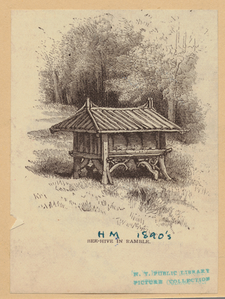
The first image below, for example, shows a bee hive in Central Park in New York City. I love the rustic features of this hive. Looks a bit like a top bar hive, doesn't it?
Learn more about this historical beekeeping image on the NYPL website.
Learn more about this historical beekeeping image.
Learn more about this historical beekeeping image.
Learn more about this historical beekeeping image.
Learn more about this historical beekeeping image.
Learn more about this historical beekeeping image.


3.08.2008
Top Bar Hive Spring Management Tips for Beekeepers
 Chomping at the bit for spring? I know I am.
The helpful human named Gary over at Hirschbach Apiary has an interesting and timely article on spring management tips for top bar hives.
The article provides a nice "springboard" for pondering and planning for this exciting time of year.
The Hirschbach Apiary site features lots of good information on top bar hive design, the honeybee life cycle, seasonal management issues, screened bottom boards, ventilation (a highly under-rated challenge in beekeeping), and many other useful details on beekeeping in general and top bar hive beekeeping in particular. The overall approach focuses on sustainable beekeeping methods, with an admirable bias toward elegant simplicity.
The site includes a pithy quote by the wise and wonderful Russell Baker:
"Usually, terrible things that are done with the excuse that progress requires them are not really progress at all, but just terrible things."
Right on, Russell Baker! And right on, Hirschbach Apiaries! Check out the site and start whetting your appetite for beekeeping season '08.
9.18.2007
A Swarm's Whereabouts
Orange Hive swarmed, for the second time, on Labor Day weekend. In the morning, we saw the swarm high up in a tree near the hive, and by late afternoon it was gone to parts unknown.
Last weekend, Wren and I were taking a walk down the road and lo and behold, there were the bees in a hollow tree. Interestingly, the entrance was an eye level, which kind of surprised me. I would have expected them to choose a more elevated location, but what do I know? I'm not sure why so many of the bees were clustered outside the entrance, but there they were. The entrance hole is the little dark spot in the midst of the bees. Foragers could be seen going in carrying pollen, so I guess at least some comb has already been built.

 Unfortunately, this late-swarming group has a thin chance of surviving the winter—just not enough time to build enough comb, store enough food, and do the reproductive work needed to ensure a large enough cluster of bees to keep the tribe warm during the long, cold winter. On the other hand, the autumn weather has been kind thus far, with warm days continuing and no hard frost due for at least another week.
I've learned a lot this summer about being sure to have enough volume in the hive to accommodate the rather astonishing population of bees that can build up in a healthy colony in a relatively short time. Three swarms and a hell of a lot of bearding bees have taught me the hard way. I really like the design of the top bar hives I have been using, but suspect lack of space may have been a problem for me and the bees. A friend is building me even bigger top bar hives for use next spring and I am hopeful that this will alter some of the crowding dynamics I witnessed this year. Only time will tell.
For now, I hope you'll join me in wishing the best to the bees who set up housekeeping in the hollow tree down the road. I'll provide updates if and when there's something new to report.
8.06.2007
A Tour of the Hive
Two weeks ago, I paid a visit to the bee yard to confirm that the (previously) virgin queens had mated and were laying "the next generation" in Hive Orange and Green Hive, both of which swarmed on June 21, taking with them the old queens and leaving newly raised, virgin queens behind. I was pleased to find plenty of evidence that all was well, reproduction-wise, in both hives. Here's a quick tour of what I found. (Click the photos to view them in a larger format.)
 In these two combs, you see just what a beekeeper hopes to find: plenty of capped worker brood—the cells covered by the tan-colored, porous-looking caps in the middle of the comb. Notice that these capped cells form a nice pattern filling in the majority of cells in the the comb. This is suggestive of a good queen who has laid each of her eggs in a efficient pattern along the comb. Bordering the top of the comb, the bees store nectar (note the pale or yellowish uncapped cells) and capped honey (whitish caps).
Below that are some dark, uncapped cells in which pollen is being stored. Both food sources—honey for carbs, pollen for protein—are conveniently located above the brood cells to make it easier for the nurse bees to mix "bee bread" (pollen + nectar/honey) to feed the larvae numerous times a day over a period of several days. During this time, the larvae grow at a rapid rate. Once they are ready to morph into the winged creature we know as the honeybee, the cell is capped and the magical rearrangement of the bee's molecular biology begins.  Here you see larvae being fed and attended to by nurse bees. You also see some capped cells inside of which are larvae undergoing metamorphosis.
 Once the bees have built out enough combs for a nice, big broodnest, they start building honeycombs—combs with larger cells for storing honey and pollen that will be used during times of dearth and, of course, during wintertime when nothing's blooming and it's too cold for the bees to fly. The dark cells in this lovely bee-composition contain pollen. Along the top and upper-middle right is capped honey. There are also some as-yet empty cells and cells containing uncapped nectar.
After the bees bring nectar into the hive and deposit it in the cells, it takes some time (and effort on the bees' part—mainly through the fanning of their wings) to reduce the moisture level to the point where it becomes honey. Once it does, the bees cap the cell with wax, keeping the precious substance clean and protected for future use. As William Longgood observes in his great book The Queen Must Die, "To the bee, honey is the ultimate reality." Here's a closeup of the pollen, capped honey, and open cells. By the way, the pollen colors vary enormously as different plants come into bloom and are visited by the bees. I can't be sure, but I suspect this pollen is from white clover.
When I look at a closeup like this—and every time I visit the hive and watch how hard the bees are working—I can't help but think about how many dozens of trips by dozens of bees it takes to fill a single cell with honey or pollen. Truly, every teaspoon of honey and every grain of pollen represents a herculean effort on the part of the honeybees. And that's leaving aside the genius of the comb itself...


7.20.2007
Rebel Rebel's Queen
Last week, during a "check in" on Rebel Rebel, I was fortunate enough to see (and hear!) the queen. Below, you can see some of the workers gathered around her, kind of encircling her. She's the larger "redder" bee below them. This stance, whereby the bees face inward toward their queen, is one of the easiest ways to spot a queen. Maeterlinck describes this encircling as looking like a grandmother's brooch, while a more recent book describes it as a daisy, with the workers as the petals and the queen at the flower's core. 
Here's a better shot of the queen as she makes an all-too-brief appearance, only to be subsumed again moments later by her attentive and protective compatriots.
7.06.2007
Swarm Saga, Pt. 4 (Home at Last)
The next day, there was good news and bad news.
The good news was that the U.S. postal service (for once) came through, with a surprisingly quick delivery of the hive.
The bad news was that getting the bees into the new hive was going to be a challenge, since the bees hadn't taken at all well to the temporary hive I'd fashioned out of an Office Max (OM) carton. By that morning, honeybees were merrily camped out on the front of the box in mass quantities, and had established several mini-civilizations in the gaps between the tarp and the box, and under the box, and along the concrete blocks on which the box was positioned. Lord only knows where the queen was in all that mess, or how I was going to get these disparate subpopulations into a single hive body.

Avoiding the inevitable moment of truth, I busied myself with preparing the new hive. I started by drilling three upper entrance holes in the front. (These entrances, along with the long narrow front entrance along the bottom of the hive, provide ventilation—an underrated issue in beekeeping—and give the bees a way to exit the hive for brief cleansing flights on warm winter days if snow has blocked the main entrance.)
Next, I began the pleasant task of applying dabs of melted beeswax to the guide bar on each top bar to provide an invitingly scented bee environment, and to encourage the bees to build their comb nice and straight along the top bar. (It's important to be able to remove each top bar to inspect the hives and carry out certain manipulations that promote the colony's well being over the course of the year. If the bees build their comb out of alignment with these bars, it becomes impossible to move the bars without destroying the comb and undoing lots of bee-labor, thus setting them back in their quest for overwintering capability and longterm survival.)

 Each of these top bars will go face down along the top of the hive, with the guides facing downward.
Last but not least, I added a drop or two of lemongrass oil to the interior of the hive body. Apparently, this scent has been found to encourage honeybees to accept a new hive body, reducing the incidence of absconding. (Which, by the way, is quite different from Colony Collapse Disorder.)
I set the newly prepped hive outside in the sun, scrawled the name Rebel Rebel on the top cover, and waited until dusk. I'd been told that hiving at this time might further increase the chances the bees would accept the hive. I guess the thinking is, once they spend the night there, some level of attachment is created, especially if the home is a suitable one. And it probably goes without saying that a delicate procedure like hiving a swarm is best accomplished in fading light with minimal visibility. Not.
As dusk approached, I transferred one honeycomb and one comb of brood from Hive Orange into the new hive body to help the bees get started in there and provide some sustenance during their initial adjustment.
My able partner-in-swarmcatching-crime, Karen, had returned to the city, so I was on my own for this final phase in the swarm hiving process. I carried the new hive body to the bee yard and positioned it on the ground by the OM box and the legions of AWOL bees, who reminded me of nothing so much as a mob of deadheads trying to find their way through the parking lot after a particularly long-winded Grateful Dead concert.
I then brushed, shook, cajoled, directed, herded, ushered, scooped, hand-delivered, and, yes, dumped as many bees as possible into the new hive from their myriad locations under the tarp, between the holes in the concrete blocks, and within and without the OM box itself. I removed the OM box from its spot on the concrete blocks and lifted the new hive into position on the concrete blocks (Honeybees' GPS is finely tuned; the new hive had to be located just where the old hive was in order for the bees to orient to it properly.) I then closed the top, and went home for a much needed glass of beer.
As you can see, in spite of all their lollygagging here, there, and everywhere around the OM box, it seems the bees had (to some degree) accepted their temporary home by beginning to build comb on the lid—a sight I found inexplicably poignant. On the other hand, they'd begun doing the same thing under the tarp, so who knows what would have happened if they'd been left to their own devices there?
The next morning, I was pleasantly surprised to find the bees still in and around the hive. Many were clustered on the exterior, but by now I was getting used to that sort of behavior. Like the wonderfully enigmatically wild animals they are, the bees are going to do not what the books say they will do, nor what you expect them to do, but whatever they are moved to do. In this respect, they remind me very much of house cats.
For the time being, it seemed all was well with Rebel Rebel.
But the time being is, by definition, a painfully fleeting thing. The very next day, following a brief, respectful and clearly premature inspection of the hive, bees started pouring out the front entrance in waves and flying tumultuously skyward in a behavior disturbingly reminiscent of swarming. I couldn't blame them. They were understandably antsy and anxious and seeing my face yet again must surely have upset them. Learning Curve Lesson #799: Leave the bees alone, will ya???
I never did see whether the swarm-like throngs returned to Rebel Rebel, but after that incident, it seemed to me, there were fewer bees in the hive. Did some actually leave and, if so, had all-important queen departed with them? Did they all return once I was out of earshot and simply create the appearance of fewer bees because they were now getting organized with comb-building and nectar-gathering? As a new beekeeper, I am still in the earliest phases of learning to interpret my observations; I look forward to the day when I can better the connect the bee-dots.
Even with its (seemingly) smaller work force, the Rebel Rebel bees have been working hard at building comb, gathering nectar, and trying to build things up in there. But the ranks looked small and I wondered whether they'd be able to pull together the critical mass needed to build up their population and honey stores to a level where they could survive a long, cold Northern winter. To us, the season of snow and subzero temperatures seems far away, but for the bees, in a sense, it is just around the corner, with an unthinkable amount of work to be accomplished between now and then.