3.27.2008

Urban Bees & How to Help Them

Two worthwhile new articles on the topic of biodiversity among bees in urban settings have caught my wandering eye of late.

The first is the cheerily titled: "Bee Richness and Abundance in New York City Urban Gardens." Incredibly, the authors found 1,145 individual bees representing 54 species while canvassing community gardens in East Harlem and the Bronx. (Props to bee-boy Thew for bringing this one to my attention, and for posting the downloadable PDF on our Brooklyn Beekeeping Meetup, where all can enjoy it. Go here and click the link called "NYC Urban Garden Bees.")The second article appears in the latest issue of Orion, perhaps my all-time favorite magazine. This article, "The Headbonkers Ball," describes the amazing variety of native bees thriving in urban areas of California. Here's a taste:

"As urban and agricultural development in California has obliterated the native bees’ natural habitat, many of the state’s more than fifteen hundred species of natives have adapted and persevered in cities. Urban environments have proved biologically richer than the vast expanses of rural, agricultural land in California. 'It’s like a reservoir of genetic material in these urban environments,' Frankie says. 'All [agricultural areas] have is dirt and the crop that farmers want, and then they bring in bees in a box,' creating what he calls 'a monoculture in bees.'"

(The individual quoted is Gordon Frankie, an entomologist at UC Berkeley who studies native bees, among other interesting things.)

This article's main take-away lesson for those wishing to promote the existence of native bees in their own gardens: lay off the mulch!

Turns out, many native bees (like the humble bumblebee) nest in the ground and the mulch makes it impossible for them to "dig in." So, along with planting native flowers of appeal to native birds, bees, and other pollinating insects, drop the mulch habit and leave some open ground undisturbed for the bees to dig their nests in. I can't think of a more effortless way to create sanctuary.

Want to learn more? Check out this guide to urban bee gardens and bee-friendly gardening.

New Orleans Honeybee Forage

It was great to see so many honeybees during our recent trip to New Orleans. It seemed wherever anything was in bloom—from street meridians on the outskirts of the French Quarter to virtually every square inch of the garden district to the flowering peas in a wreck of a graveyard, the honeybees were there. (We saw some exquisite and unfamiliar butterflies and dragonflies, too. And my first purple martins!)

My macro lens has been failing lately, so instead of bee closeups, I'm providing here a few eh-shots of some of the many flowers on which I saw honeybees forage, plus two bonus shots.

3.25.2008

Bat Crash: The Die-off Continues

More on the frightening threat to that wonderful creature, the bat.

Unwatched Waggle?

My pal Eva was kind enough to bring an interesting New York Times article to my attention today regarding the honeybee waggle dance, distracted bees, and the power of memory.

3.20.2008

Happy Spring!

3.18.2008

"A Young Deer in a Tiger's Hand": Time, Patience & The Path To Right Action

“Last few days I had a sort of feeling, a tiger, of a young deer in a tiger’s hand. Deer really can fight the tiger? Can express. But actual fight? Our only weapon, only strength is justice, truth. But effect of truth, justice sometimes takes longer time. Weapons power is immediately there.”—Dalai Lama
Context, courtesy of the New York Times.

Learn more about the Tibetan culture, the current situation, and the Middle-Way Policy.

(Relevance to beekeeping practice on a scale from 1 to 10: 11.)

3.17.2008

George W. Bush Makes Me Gag

NPR reports on the latest nonsense involving the EPA, the air you breathe, and our sorry excuse for a president:

"The chief of the Environmental Protection Agency has authority to set the air quality standards to protect public health and the environment. But the White House is now interfering with new efforts by EPA Administrator Stephen Johnson."
Thank goodness we have only 308 days left—join the countdown.

Chinook Colony Collapse Disorder


In other bad environmental news, there's a disturbing article in today's New York Times about the total disappearance of the Chinook Salmon in the Sacramento River. The article describes the situation as "the almost complete collapse of the richest and most dependable source of Chinook salmon south of Alaska."

Checking on the Hives—Good News and Bad News

This weekend I checked on the hives using the observation windows—still too cold and wet to open them up. Hive Orange appears to be trucking along, but it seems clear that both the Rebel Rebel and Green Hive colonies have died. We had a lot of adventures together, and I'll miss them.

On our next trip up in two weeks, I plan to do a careful assessment/investigation of both of the lost hives and try to figure out what did them in. From what I can see through the observation windows, both colonies have unused, capped honeycomb. Rebel Rebel showed visual evidence of dysentery and some of the combs in the rear of the hive body looked a bit moldy—a sign of ventilation problems, perhaps.

I'll report in a couple of weeks on everything I find in doing the "autopsies" on both hives. If any experienced beekeepers are reading this and wish to comment or share observations, I welcome them.

Here are a couple of shots of what's going on inside Hive Orange. The cluster of bees begins eight bars/combs back from the hive entrance, and extends over a total of 4 combs.The bees were moving around vigorously within the cluster area. There appear to be several capped honeycombs in the middle and rear of the hive.

I want to get in there soon and assess this colony's feeding needs. I can probably transfer some honeycombs from the dead hives to help Hive Orange through until bloom-time. But I don't want to transmit disease from hive to hive, so I need to do a little homework before deciding how best to proceed.

This year, a friend has built larger top bar hive bodies for us to try out; I hope this will allow the bees to save larger stores of honey for wintertime.

In entering Year 2 of my excursion into the manifold wonders of beekeeping, I am awed by how much there is to learn and am eager to "start again" (in the words of Leonard Cohen), letting the bees (and books, and cyber-mentors) teach me what I need to know.

That's what spring is all about, isn't it? Beginning anew and listening closely to Mother Nature's illuminating communiques.

3.15.2008

Beekeeping History @ New York Public Library

The New York Public Library has a fantastic digital collection which includes, among its countless treasures, historical images of beekeeping and natural history.

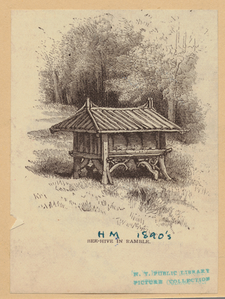
The first image below, for example, shows a bee hive in Central Park in New York City. I love the rustic features of this hive. Looks a bit like a top bar hive, doesn't it?

Bee-hive in Ramble. Digital ID: 800901. New York Public Library
Learn more about this historical beekeeping image on the NYPL website.

[Bees and beekeeping.] Digital ID: 806364. New York Public Library
Learn more about this historical beekeeping image.

Hive of the bee. Digital ID: 806354. New York Public Library
Learn more about this historical beekeeping image.

Honeycombs. Digital ID: 806368. New York Public Library
Learn more about this historical beekeeping image.

A Jamaican Negro farmer and be... Digital ID: 1228980. New York Public Library
Learn more about this historical beekeeping image.


Den naerstigen byen-houder ...... Digital ID: 1111631. New York Public Library

Learn more about this historical beekeeping image.

3.14.2008

Evocations of Spring

I gasped with pleasure when I saw this detail of “Wang Xizhi Watching Geese” by Qian Xuan on the New York Times website this morning. Both the image and the title of this painting felt so evocative of spring. The geese suddenly seem to be everywhere and the trees are indicating their intention to bloom and I for one am in a very good mood!

This contemplative image appears in connection with an article about a new show at the Metropolitan Museum of Art entitled “Anatomy of a Masterpiece: How to Read Chinese Paintings.” The new show runs through August 10, 2008. I can't wait to see it.

The Times has another one of its fab slide-shows up, so check out more of Qian Xuan.

You can learn more about this exhibit on the Metropolitan Museum of Art website.

Bee Collage of Bee Collages

At least one of these wonderful bee-collages incorporates beeswax along with imagination—can you tell which one?
1. Beekeeper, 2. bee, 3. Bee Cup, 4. Bee Cup, 5. Bee Tea - 2008, 6. Queen Edith, 7. The Bee tattoo, 8. Sentiment, 9. Queen Of Bees - ATC ACEO

Learn more about beeswax collages.

3.13.2008

New Orleans Beekeepers?

Wren and I are going to New Orleans for a few days and we'd like to connect with any beekeepers in the area. If you're a beekeeper (or know someone who is) in or around New Orleans, we hope you will let us know—leave a comment or see my email in the "Contact" box at right (scroll down a bit).

Bee Transplants & Bees on Trucks

The New York Times has a nice little slide show on a recent honeybee colony removal in North Carolina, though it's not really clear why the bees had to be removed...

In other news—tangentially related to the notion of trucking bees around—check out the cool truck I happened upon today in Brooklyn. I explained to the guy driving it that I'm a beekeeper and asked permission to photograph it. We had a nice conversation about the honeybees; he'd seen the recent 60 Minutes program entitled "What's Wrong with the Bees?" and was concerned.

That's one industrious and patriotic little bee!

Bonus item on the theme of bees and vehicles: some like-minded soul in my neighborhood has this fabulous license plate.

3.12.2008

NYC Drinking Water—The Onion Asks the "Man on the Street"

The Onion

Sedatives In New York Drinking Water

A test of the reservoir that supplies drinking water for New York city turned up traces of numerous drugs, including caffeine, hormones, and...